20 Feb 2025
The workshop took place at Humboldt University of Berlin and set out to address topics such as:
- User diversity: Which aspects of human speech and language production affect the performance of LSLMs?
- Language use: How are LSLMs able to cope with different languages, dialects, and sociolects? How do they deal with code switching?
- Human adaptation: How does the use of LSLMs affect language comprehension and production? Which alignment effects occur, and in which time spans?
- Model adaptation: How do LSLMs need to be designed to cope with speech and language diversity? How do training and finetuning affect performance?
- Inclusion: What data and technologies are necessary to better cope with diversity in LSLMs?
With my colleague Erfan A. Shams, we presented our work on
How Transformer-based ASR Models Handle Diverse Signal Perturbations
at the Segmental Level.
Together with Dorothea Kolossa (TU Berlin), Georg Rehm (DFKI), and Pierre Zweigenbaum (LISN), I participated in a panel discussion on future research directions that tackle diversity issues in LSLMs, which was moderated by
Pia Knoeferle (HU Berlin) and Sebastian Möller (TU Berlin).
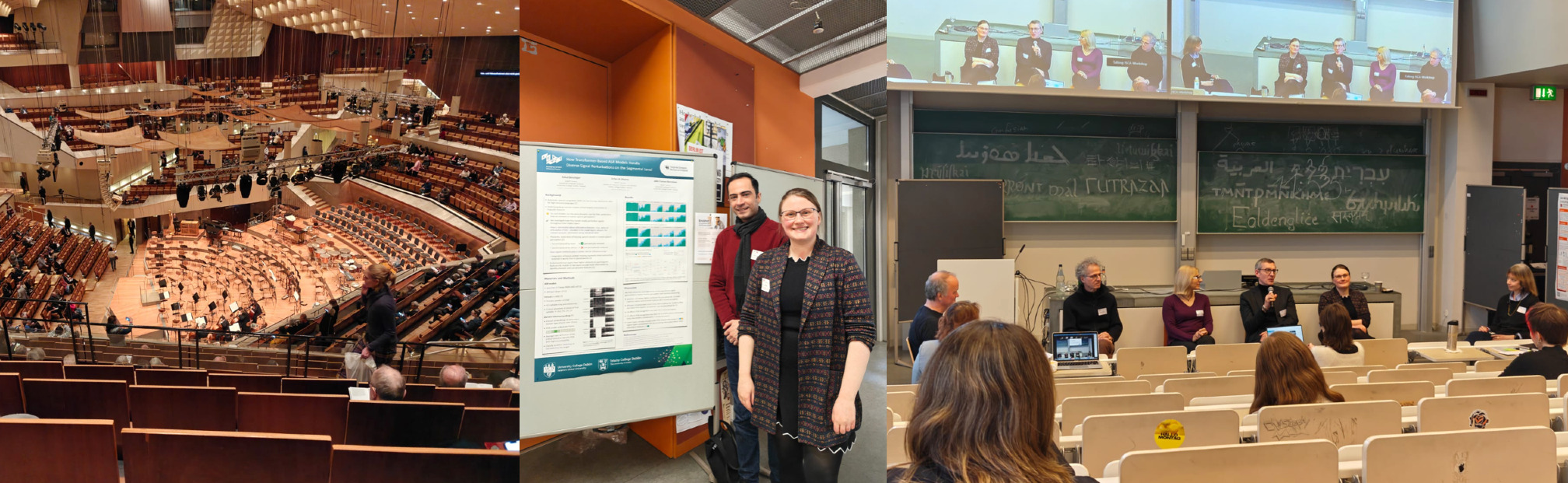
We concluded our trip with a concert at the Berliner Philharmonie. 🎶
Under the motto “Paradise lost?”, the orchestra and choir conducted by Marin Alsop intepreted pieces by
Outi Tarkiainen, Brett Dean,
Aaron Copland, and Heitor Villa-Lobos.
12 Dec 2024
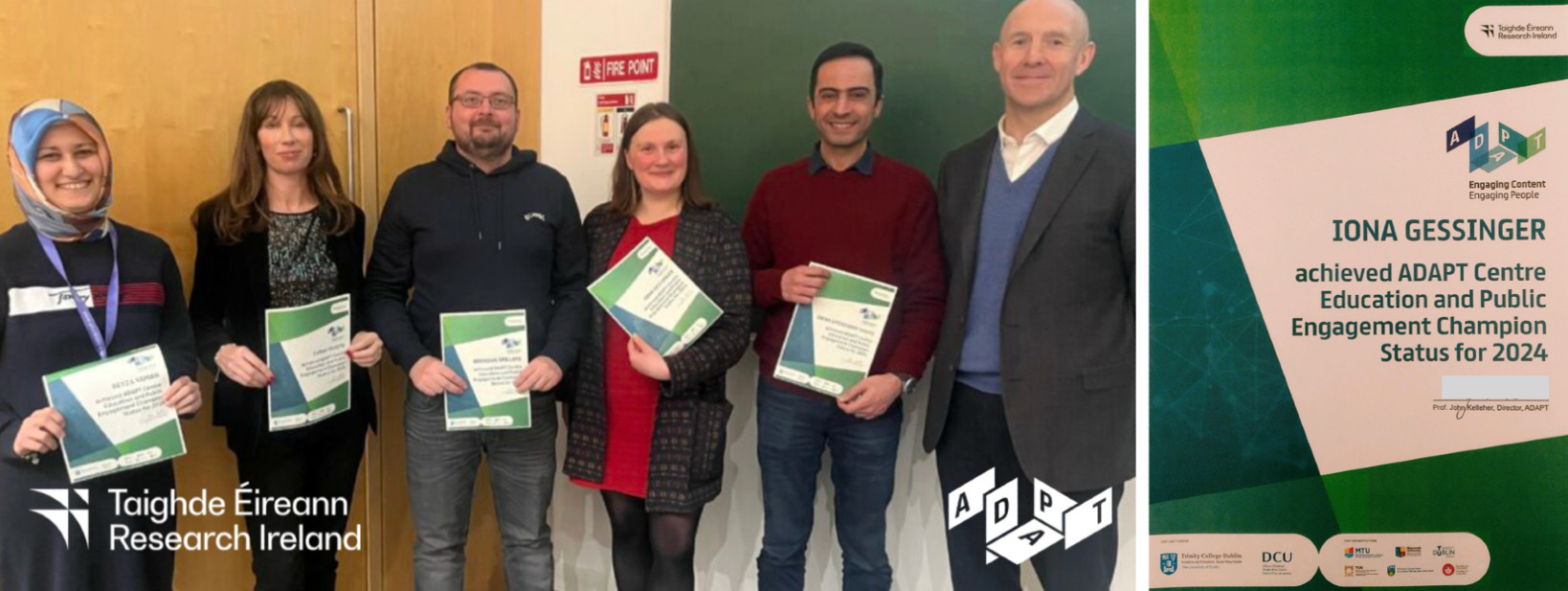
Together with my colleagues Beyza Yaman, Esther Murphy, Brendan Spillane, and Erfan Shams, we received a recognition as Education & Public Engagement (EPE) Champions by ADAPT director John Kelleher.
ADAPT EPE champions are individual team members who lead, or significantly contribute to, the development and/or delivery of EPE strategy and activities. These champions not only play a pivotal role in the creation and delivery of EPE strategies and initiatives, but they also inspire and empower their peers to engage actively.
I was further shortlisted for the Gender, Equality, Diversity, and Inclusion (GEDI) Recognition Award!
The ADAPT GEDI Recognition Award honours significant contributions made to promote equality, diversity, and inclusion within ADAPT. This includes advancements in accessibility and inclusivity across workplace activities, training, community engagement, research innovations, communication, or other aspects of ADAPT’s work.
Absolutely delighted to be an active member of ADAPT, beyond the research activities! 🌷 💕
09 Dec 2024
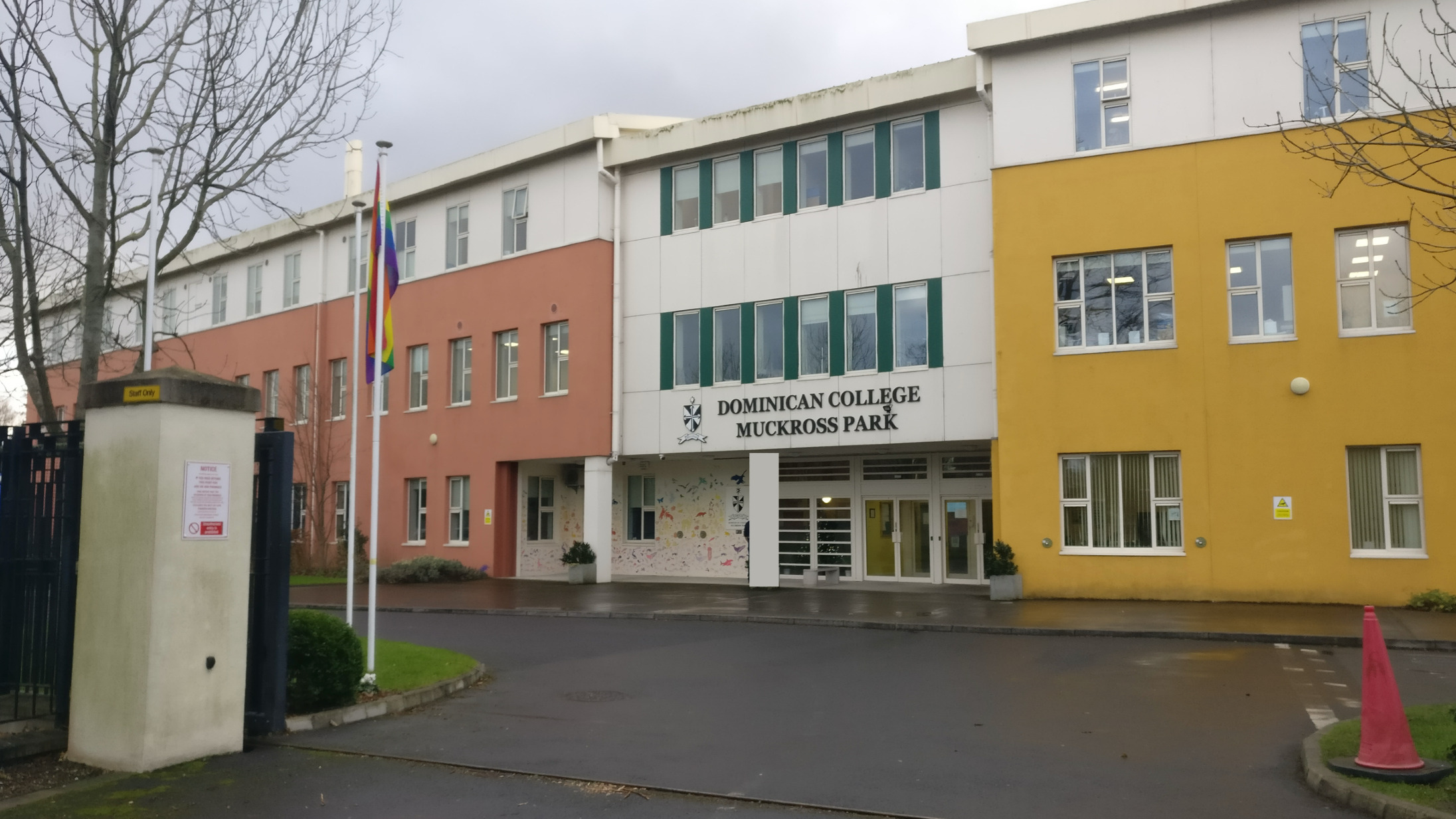
Leading a workshop to prepare students for the All Ireland Linguistics Olympiad (AILO) is always an end of year highlight.
This year I visited Muckross Park College in Dublin.
The workshop was also attended by students from Oatlands College, Harold’s Cross Educate Together Secondary School, Catholic University School and The Teresian School.
The group did an amazing job at solving puzzles involving three different languages that were unfamiliar to them: Permyak, spoken by around 60,000 people in the north-eastern part of European Russia, Lalana Chinantec, spoken by around 10,000 people in the Oaxaca region of Mexico, and Umbrian, an extinct Italic language once spoken in the ancient Italian region of Umbria.
In July 2025, the international final of AILO will take place in Taipei, Taiwan.
But first, the 100 most successful puzzle solvers from all over Ireland will compete in the national final at Dublin City University in March.
I hope to see some of the students I met today again at the national final — good luck to everyone in the preliminary round! 🤞
16 Nov 2024
It has been a while since I joined a conference online. For ⬛ BlackboxNLP, a workshop of the Empirical Methods in Natural Language Processing
(EMNLP) conference, we decided not to travel to Miami, but to give the online option a try.* Together with my colleague Erfan A. Shams, we were happy to present our paper Uncovering Syllable Constituents in the Self-Attention-Based Speech Representations of Whisper in the EMNLP space on Gather.
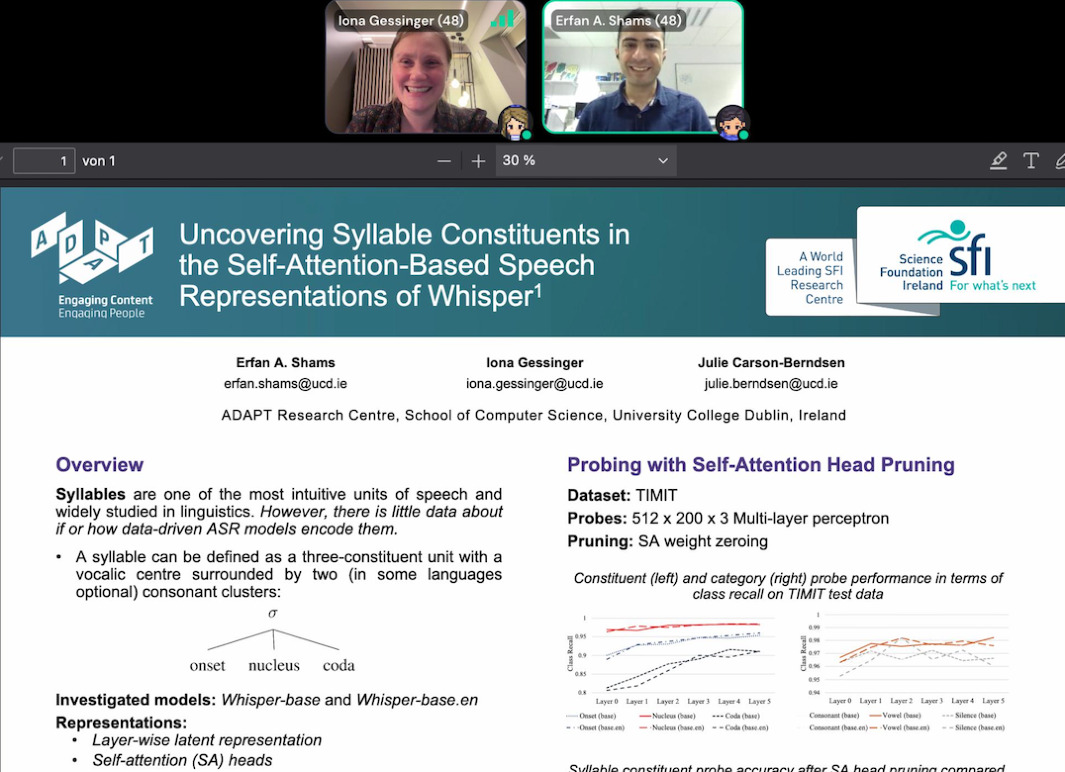
*Offering an online option for conferences provides researchers who are unable to travel with the valuable opportunity to publish their work. In most cases, however, the online experience falls short of the richness and engagement of in-person participation. As a community, we must continue to explore effective alternatives that better capture the essence of the in-person conference experience. An online option alone is no solution to the fact that the careers of many researchers are obstructed by issues such as unsuccessful visa applications. Those of us who are not affected must remain aware of the privilege of unrestricted travel❗
14 Nov 2024
1️⃣ 📖 If you wonder how users of ChatGPT perceive the system’s communicative abilities and how this perception is shaped by first-hand
experience with the system, have a look at our article
ChatGPT and me: First-time and experienced users’ perceptions of ChatGPT’s communicative ability as a dialogue partner with
Katie Seaborn (Tokyo Institute of Technology, Japan), Maddy Steeds, and
Ben Cowan (University College Dublin, Ireland). ➡️ This article is #openaccess 🔓 until January 03, 2025 via this link.
2️⃣ 📖 Would you consider using automatic speech recognition (ASR) for the transcription of conversational speech data?
You may be interested to read about
What ASR can and cannot do for conversational speech transcription in our article with
Sam O’Connor Russell and Naomi Harte (Trinty College Dublin, Ireland), Anna Krason
(Moss Rehabilitation Research Institute, USA), and Gabriella Vigliocco (University College London, UK). ➡️ This article is #openaccess 🔓